

Saturday, April 30, 2011
A New Pinky Exercise
Courtesy of flamenco guitarist Rayito...
Giannini GWNC 4 Asturias Handcrafted Classical Guitar (Acoustic, Nylon)

Friday, April 29, 2011
Reading in the Studio
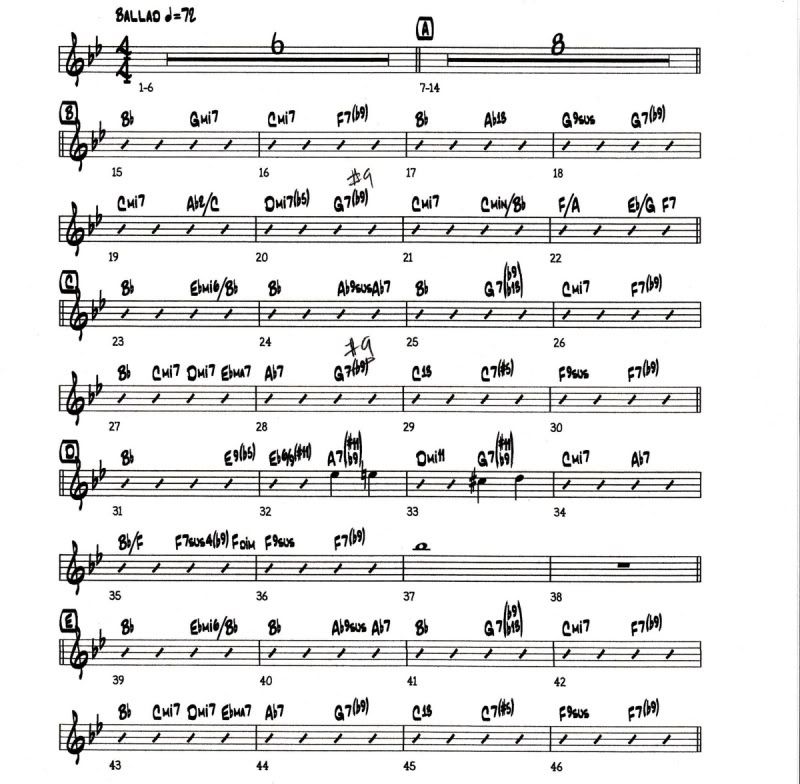
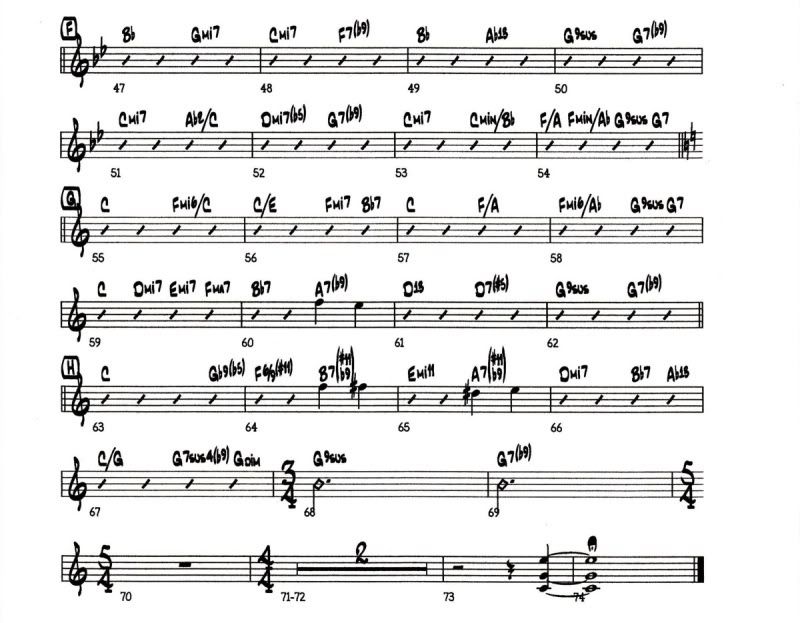
The following chart was from a recent session. The producer wanted me to just play "footballs" or whole note or in this case half note chord stacks. A video of how I played through it is posted below.
Ted Greene's Chord Chemistry is a classic lexicon of chord shapes. Be warned, it's intense.
Wednesday, April 27, 2011
Session with Mercy Miles
You can't see me, but you can hear me.
I'm playing a Strat through a Keeley Compressor, a VooDoo Labs Sparkle Drive and a vintage blackface Fender Princeton.
Voodoo Lab SD Sparkle Drive Overdrive Pedal
Keeley Compressor 2 Knob Effect Pedal
American Deluxe Stratocaster "V" Neck (2 Tone Sunburst)
Fender 65 Princeton Reverb 15W 1x10 Tube Guitar Combo Amp, Black
I'm playing a Strat through a Keeley Compressor, a VooDoo Labs Sparkle Drive and a vintage blackface Fender Princeton.
Voodoo Lab SD Sparkle Drive Overdrive Pedal
Keeley Compressor 2 Knob Effect Pedal
American Deluxe Stratocaster "V" Neck (2 Tone Sunburst)
Fender 65 Princeton Reverb 15W 1x10 Tube Guitar Combo Amp, Black
Wednesday, April 20, 2011
Reading in the Studio
This was a session for a film.
"Fender sound, finger picked, gentle, ambient" I kind of approached the way Mark Knoffler might.
The composer wanted as many of these notes to ring out as possible. The chords were just guides, what he wanted was just the notes. Notice my note, a natural sign, in bar 378, probably there because I had played an Ab running through it thinking the A natural and the F7 were typos. They weren't.
The reason the bar numbers were so high is because when composers get a film it's usually a single mpg file and they drop it into ProTools or Logic or Digital Performer and then they write to that one long file. By the end of the film you could be tracking on bar 1000 or higher.
Notice the slides in bars 379 and 380. It would be difficult without a capo to let those notes ring. So I probably reached for my capo and punched in. Or I could've played the whole take with the capo on the first fret.

Sunday, April 17, 2011
Two Simple Exercises
Here are a couple of basic exercises for developing finger independence.
Start on the first fret of the first string (F) with your first finger, then play the second fret with the second finger, third with the third and fourth with the fourth and back again. ie - 12344321
Now move up a fret and repeat. All the way to the 9th fret (so your pinky is on the 12th fret) and back down. Repeat on each string. If playing on classical guitar alternate your right hand fingerings as well to bring a greater challenge.... imimimim, mamamama, iaiaiaia, imamimam, pppppppp, etc.
The next exercise is 14342434 and should utilize the above variations.
Start on the first fret of the first string (F) with your first finger, then play the second fret with the second finger, third with the third and fourth with the fourth and back again. ie - 12344321
Now move up a fret and repeat. All the way to the 9th fret (so your pinky is on the 12th fret) and back down. Repeat on each string. If playing on classical guitar alternate your right hand fingerings as well to bring a greater challenge.... imimimim, mamamama, iaiaiaia, imamimam, pppppppp, etc.
The next exercise is 14342434 and should utilize the above variations.
Saturday, April 16, 2011
Cool Site #11 - Musician Wages
Musician Wages is good resource for those who interested making a living as a musician and are realistic about it.
Friday, April 15, 2011
Reading in the Studio
Here's an interesting one.

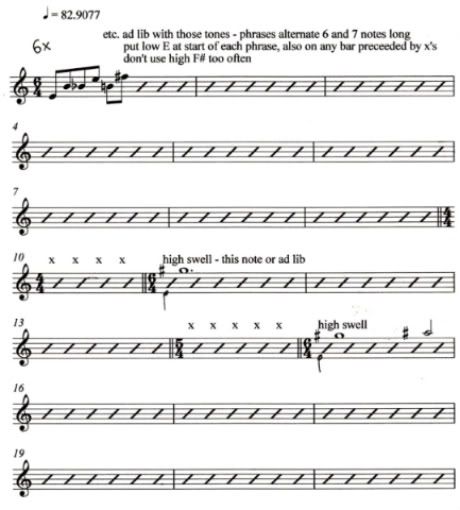
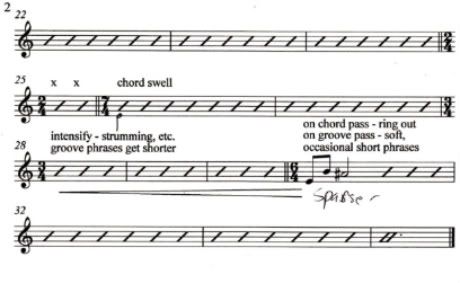
Note the tempo, 82.9077. Tempos like these are not uncommon when scoring to picture.
The composer is wanting me to play the first 6 notes randomly throughout the cue, where the slashes are, except for a few different spots where he wanted specific notes. Given the meters (6/4, 4/4, 5/4, 2/4, 3/4, 7/4), it would've have been a difficult chart to track had not the composer very thoughtfully added four rims shots (where the x's are) before every specific note he wanted. Counting odd meters and being random with a given set of notes can be very difficult as you are using two different sides of your brain. The rim shots allowed me to concentrate on the randomness.
Pretty sure I just voiced on the top four strings... E on the D-string, Bb on the G-string, open B-string, and the E and F# on the E-string.
This was tracked with massive doses of reverb on my end so it had to be done in one pass. After a couple of run-throughs it was.
Thursday, April 14, 2011
Wednesday, April 13, 2011
How to Get Guitar Students
Here's a video I did of the long ago posted tips below....
Teaching private lessons can be a great way to supplement your income, pass on your knowledge and keep on the latest music trends. I have taught for over 35 years now.
It started when a teacher at my Jr. High saw me carrying a guitar case and asked if would teach her son how to play. She offered to pick me up at my house, teach her son, take me home and pay me $5! Sure I told her. That was the beginning. By the time I was 20 I was teaching 40 students five days a week at a store in my hometown of Indianapolis.
When I moved to Los Angeles to pursue a career as a studio musician I had to start from scratch. Back at the store they were charging $7 per half hour lesson and paying me $9 an hour. Three times minimum wage. So I thought charging $10 per hour lesson in 1983 would be a good place to start. A dollar more for me and a four dollar savings for my students. It was slow building up to even a fraction of my midwestern numbers. I didn't have a storefront doing all the leg work for me.
Flash forward 30 years, if I even teach at all, I charge $75 per hour. Over the years I found a few things that can help you build up the numbers and I'll share them here with you now.
1. Play out more. If you're like me, you're playing out in public a bit and you will get asked if you teach. If you aren't playing out find some places you can play even if it's only for tips. Close to home if at all possible. No one wants to drive a half hour to guitar lessons. This makes it easier to get students.
2. Give away freebies. Offer a free lesson for anyone who brings you a new student. Once the new student has taken their fourth lesson I would then give the freebie to that existing student. Even better, get someone who isn’t taking lessons to bring you a new student and give them a free lesson. This can net you two new students. And unlike advertising it doesn't cost you anything. Just your time. Another tip is to give away free lessons at a silent auction charity type thing. Maybe two free hour lessons. Someone wins lessons with you for cheap, the charity makes some coin and you’ve got a potential new student.
Teaching private lessons can be a great way to supplement your income, pass on your knowledge and keep on the latest music trends. I have taught for over 35 years now.
It started when a teacher at my Jr. High saw me carrying a guitar case and asked if would teach her son how to play. She offered to pick me up at my house, teach her son, take me home and pay me $5! Sure I told her. That was the beginning. By the time I was 20 I was teaching 40 students five days a week at a store in my hometown of Indianapolis.
When I moved to Los Angeles to pursue a career as a studio musician I had to start from scratch. Back at the store they were charging $7 per half hour lesson and paying me $9 an hour. Three times minimum wage. So I thought charging $10 per hour lesson in 1983 would be a good place to start. A dollar more for me and a four dollar savings for my students. It was slow building up to even a fraction of my midwestern numbers. I didn't have a storefront doing all the leg work for me.
Flash forward 30 years, if I even teach at all, I charge $75 per hour. Over the years I found a few things that can help you build up the numbers and I'll share them here with you now.
1. Play out more. If you're like me, you're playing out in public a bit and you will get asked if you teach. If you aren't playing out find some places you can play even if it's only for tips. Close to home if at all possible. No one wants to drive a half hour to guitar lessons. This makes it easier to get students.
2. Give away freebies. Offer a free lesson for anyone who brings you a new student. Once the new student has taken their fourth lesson I would then give the freebie to that existing student. Even better, get someone who isn’t taking lessons to bring you a new student and give them a free lesson. This can net you two new students. And unlike advertising it doesn't cost you anything. Just your time. Another tip is to give away free lessons at a silent auction charity type thing. Maybe two free hour lessons. Someone wins lessons with you for cheap, the charity makes some coin and you’ve got a potential new student.
3. Be Flexible. Is there someone who would like to study with you but lives far away? Offer to teach them twice a month for an hour instead of every week for 30 minutes. I had a student that took a two-hour lesson once a month because he lived over an hour away. Does your student's son want to learn too? Let him watch for free. If you are flexible with rescheduling than your students will reciprocate when you need to reschedule to do that session or important, well-paying gig.
4. Live in a nice area. Or at least adjacent to one. This will allow you to charge a little more than average. And take on kids. When they start jamming on Nirvana for their friends that's better than taking out an ad on Facebook. Plus because your students tend to be younger than you, and truthfully more aware of the cutting edge of music, you'll hear about the newest artists before almost anyone else.
5. Keep your students. You could get a new student and lose two for a net loss of one. (I know obvious). Never would I raise fees on existing students only new ones. Every five years or so I would raise my lessons $5 per half hour. But only on the new ones. Let the older students know if they recommend someone they will be paying more. This makes them feel special that they've locked in a lower rate. Attrition would take care of those paying less. Give percs. Give loyal students a free set of strings or picks you got at the NAMM show. Or better yet take them to the NAMM show. Give them tickets to your gigs. Put them on guest lists. Free CD's. You get the idea. You could also record the lessons and send them the mp3. Just give them value for their money and they'll keep coming back and bring their friends.
6. Advertise. On bulletin boards at churches, schools, music stores, the grocery store. But do something to make your advert stand out. A clever phrase, nice graphics, offer a free lesson, etc. Advertise with Facebook or Groupon. Tweet.
Now I don’t teach at all because I’m doing so much session work and writing and gigging. But teaching kept me in the game. Paid my bills. And the young kids helped me stay current.
5. Keep your students. You could get a new student and lose two for a net loss of one. (I know obvious). Never would I raise fees on existing students only new ones. Every five years or so I would raise my lessons $5 per half hour. But only on the new ones. Let the older students know if they recommend someone they will be paying more. This makes them feel special that they've locked in a lower rate. Attrition would take care of those paying less. Give percs. Give loyal students a free set of strings or picks you got at the NAMM show. Or better yet take them to the NAMM show. Give them tickets to your gigs. Put them on guest lists. Free CD's. You get the idea. You could also record the lessons and send them the mp3. Just give them value for their money and they'll keep coming back and bring their friends.
6. Advertise. On bulletin boards at churches, schools, music stores, the grocery store. But do something to make your advert stand out. A clever phrase, nice graphics, offer a free lesson, etc. Advertise with Facebook or Groupon. Tweet.
Now I don’t teach at all because I’m doing so much session work and writing and gigging. But teaching kept me in the game. Paid my bills. And the young kids helped me stay current.
Tuesday, April 12, 2011
Monday, April 11, 2011
Books to Help Sight Reading
Here are some books that can help you work on your sight-reading chops...
A Modern Method for Guitar - Volumes 1, 2, 3 Complete - This is good one for beginners at reading. But it progresses pretty quick - stacked triads on page five!
Advanced Reading Studies for Guitar: Guitar Technique (Advanced Reading: Guitar) - more of the same
Melodic Rhythms for Guitar - This is a great book as it teaches you new rhythmic figures on one pitch and then uses them in realistic melodies.
Contemporary Jazz/Rock Rhythms for Treble Clef Instruments - Heres another good one.
For Guitar Players Only - By Tommy Tedesco the most recorded guitarist in history. I had this book. The exercises are a little random, which can make for good sight reading in it's unpredictability. Worth it for the stories. All true. And for the real session charts from the 70's and 80's in the back.
Also check out trumpet and clarinet study books. Flute is good for reading ledger lines. You might be able to find them at used book stores or thrift stores. I've never payed more than a dollar for one.
Practice your reading with another guitarist. Maybe someone better than you. Like playing tennis with a better player it forces you to rise to the occasion.
Here's the thing, if you are not likely to use it you are not likely to retain it. See if you can fine some reading bands, often swing bands or big bands that don't perform so much as practice. The Wire Choir here in LA is an example of one such opportunity. Also start writing music out. Write practice pieces for yourself that emphasize your weaknesses.
I worked it when I was in HS and college because I wanted to move to LA to be a session guitarist. Which I now am. Still surprised how rarely I need it. Read more cocktail napkins than bona-fide charts.
A Modern Method for Guitar - Volumes 1, 2, 3 Complete
- This is good one for beginners at reading. But it progresses pretty quick - stacked triads on page five!Advanced Reading Studies for Guitar: Guitar Technique (Advanced Reading: Guitar)
- more of the sameMelodic Rhythms for Guitar
- This is a great book as it teaches you new rhythmic figures on one pitch and then uses them in realistic melodies.Contemporary Jazz/Rock Rhythms for Treble Clef Instruments
- Heres another good one.For Guitar Players Only
- By Tommy Tedesco the most recorded guitarist in history. I had this book. The exercises are a little random, which can make for good sight reading in it's unpredictability. Worth it for the stories. All true. And for the real session charts from the 70's and 80's in the back.Also check out trumpet and clarinet study books. Flute is good for reading ledger lines. You might be able to find them at used book stores or thrift stores. I've never payed more than a dollar for one.
Practice your reading with another guitarist. Maybe someone better than you. Like playing tennis with a better player it forces you to rise to the occasion.
Here's the thing, if you are not likely to use it you are not likely to retain it. See if you can fine some reading bands, often swing bands or big bands that don't perform so much as practice. The Wire Choir here in LA is an example of one such opportunity. Also start writing music out. Write practice pieces for yourself that emphasize your weaknesses.
I worked it when I was in HS and college because I wanted to move to LA to be a session guitarist. Which I now am. Still surprised how rarely I need it. Read more cocktail napkins than bona-fide charts.
Sunday, April 10, 2011
Cool Site #10 - Charlie Christian Tribute
Charlie Christian Tribute - Guitarist who influenced Wes Montgomery and George Benson among others. Free transcriptions.
Subscribe to:
Posts (Atom)